
This blog describes my day to day experience and reflections as an online art teacher. This blog was used in part for my Master's Thesis project. I thank everyone who has read it. Though my project is complete I will continue to use this blog to share my experiences and answer questions.
Saturday, October 26, 2013
Google Glass in the News
I apologize for my lack of entries lately. I have been busy presenting to my school about Google Glass and telling my story to the local news. Check out the story here. Coming up soon: I am trying out FIP (formalized instructional practice) in my classroom next week. I look forward to seeing how students respond and sharing the results with you!


Sunday, September 15, 2013
Thursday, September 12, 2013
From Recall to Higher-Order Thinking
This year is all about growth! Both student growth and teacher growth. With common core and an increased focus on literacy in the art classroom, we are challenged to look at our weaknesses and evolve to meet new standards of learning. Last year, my team and I spent a large amount of time working on converting our curriculum to include more writing and reading. Two years ago, I went through the process of adding quizzes to my classroom to check student's ability to recall the information they were assigned to read. This mostly assured me that students were being held accountable for reading the material as sometimes they would get away with simply completing the project by looking at examples. Now, my task is to take a basic recall quiz and turn it into one that pushes students to answer questions about comprehension, application, analysis, synthesis, and evaluation.

I used a very simple and helpful guide I found on pinterest to learn more about how these questions could appear in the art classroom. Then, I reflected on my current quiz questions which included one such as this:
1. Which objects appear the largest in a drawing?
A. Objects in the foreground
B. Objects in the middle ground
C. Objects in the background
The answer to this question was simply provided in the assigned reading and it does not ask students to apply their knowledge. So I came up with a series of new questions that challenge students to apply and then analyse.
Examples:
Apply: In this image, which part is the foreground?

Analyze: Which option shows the correct use of proportion?

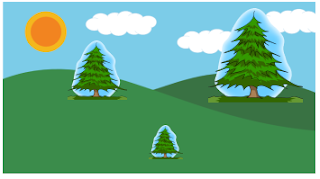


And I have even added a question where students have to choose the drawing that shows the most depth in order to fulfil the evaluation question. I believe these new questions will test more than if my students can read the information and put it down on paper but if they actually understand it.

I used a very simple and helpful guide I found on pinterest to learn more about how these questions could appear in the art classroom. Then, I reflected on my current quiz questions which included one such as this:
1. Which objects appear the largest in a drawing?
A. Objects in the foreground
B. Objects in the middle ground
C. Objects in the background
The answer to this question was simply provided in the assigned reading and it does not ask students to apply their knowledge. So I came up with a series of new questions that challenge students to apply and then analyse.
Examples:
Apply: In this image, which part is the foreground?


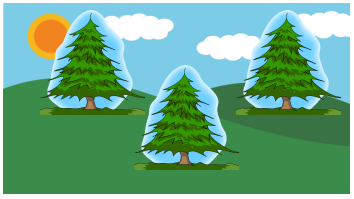

And I have even added a question where students have to choose the drawing that shows the most depth in order to fulfil the evaluation question. I believe these new questions will test more than if my students can read the information and put it down on paper but if they actually understand it.
Thursday, August 22, 2013
Welcoming
Over the last week I have been preparing my classroom for students. Now, of course that doesn't mean I am putting up posters or arranging chairs and supplies. For me, it's all digital organizing. I've been pulling web content together from my Gold Course (houses all of the Art 1 curriculum pages) and making my own adjustments. One of these adjustments includes a welcome video message to my students which I hope will help ease their fears of being judged on talent in my class. A common barrier I run into with students is their belief that they cannot draw, and therefore will fail my class. I spend many phone calls convincing them that this isn't true. This year I created a video to address this concern right away, and it also let's them see my face on their first day.
I also created another Glass video about my Pattern Project. I am hoping to engage and excite students with these videos year. Tomorrow, my students begin the 2013-2014 school year. I look forward to our adventures!
I also created another Glass video about my Pattern Project. I am hoping to engage and excite students with these videos year. Tomorrow, my students begin the 2013-2014 school year. I look forward to our adventures!
Friday, August 9, 2013
Preparing for a Better Year, Every Year
I have had a long and exciting summer and I getting very excited for the 2013-2014 school year to begin. Between new technology tools, implementing common core standards, and carrying out SLO's, we are in for some big changes. I am working on bettering my asynchronous content through more varied visual examples. At the end of last school year, I surveyed my students about how they best learned in my class. The results surprised me.
 I had an idea that my WebEx lessons (live/synchronous lessons) would score highly with my students, but I was surprised at how helpful they found my step-by-step instructions. Last school year only 2-3 of my lessons actually had step-by-step lessons pages. Therefore, I have big goals for this year! I know that I want to implement step-by-step guides and videos into every lesson in my asynchronous content. Google Glass continues to be an innovative and convenient way to do this. Below are two new lessons that are ready to go for my classroom. One is a step-by-step guide, and one a video, both made using Glass.

Thursday, August 1, 2013
Understanding Linear Perspective Through Glass
In the past I made a video about how to draw a building using one or two-point linear perspective but I hadn't yet made a video about how to relate linear perspective to what my students see in the world around them. I attended the Ohio State Fair today and recorded a fun video about linear perspective that will hopefully engage students and help them understand that linear perspective isn't simply a drawing technique but also relates to the way they see.
Wednesday, July 3, 2013
Practicing with Glass: Proportion Lesson
I picked up Google Glass last week and I am eager to start making videos for my classroom. They take a bit of getting used to so I am starting to practice before I go on vacation for several weeks. Here is my first clip that I will combine with more about the lesson later on for use in my classroom. It demonstrates the basics about proportion, foreground, middle, and background. Let me know what you think!
Subscribe to:
Posts (Atom)