Showing posts with label e-learning. Show all posts

Tuesday, May 24, 2016

Collaborative Class Project in Art Club Online

For years I have dreamed of creating a mural or other large artwork with my students. Logistically this can be a bit of a challenge with my students being scattered all over Ohio without the ability to converge in one location very often outside of graduation and perhaps prom. So this year I set out to make my dreams come true with a collaborative project for my Art Club students.


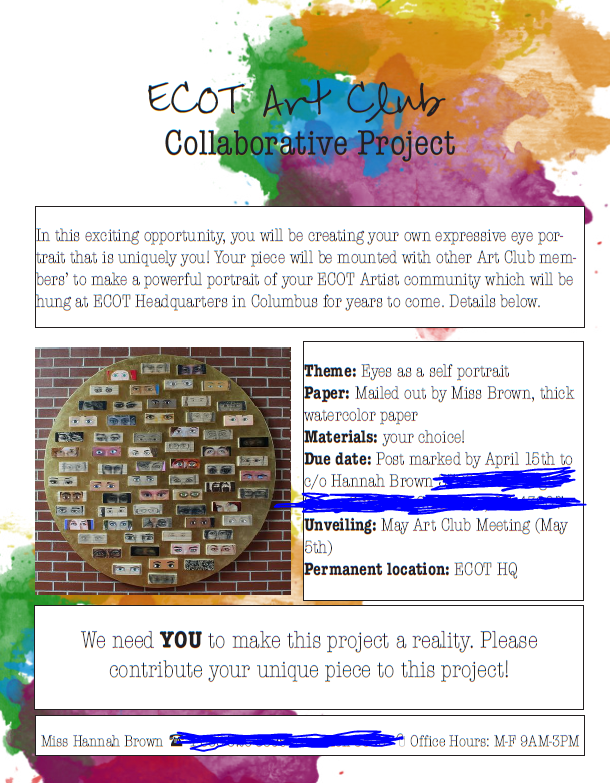
First came first, choosing a theme. For this one I was inspired by "The Eye Project" (above, more photos here). I liked this project because it shows the diversity of students but also ties them all together into one composition. Myself and the other Art Club facilitators held a meeting with students to discuss how eyes express ideas and emotions within artwork. We provided tutorials for creating eyes and encouraged students to think beyond a typical realistic eye if they wished.


Second, I had students sign up so I could mail them the materials they needed for the project-in this case that included a letter of directions and a rectangular piece of watercolor paper. The students chose what media to work with for the project, created their compositions, and mailed them back to me. Then, I had a blast putting it all together. See below!


The final product!


Tuesday, March 15, 2016

Process and Progress Checks

I think one of the biggest challenges I have teaching art online is helping students mid-project as I would if I were walking around a brick and mortar classroom. Of my two courses, Art 1 is the most fast-paced, and I am able to see a student's growth and process as they progress from project to project as well as through practice sketches and one-on-one sessions. However, I rarely see an "unfinished" project before I see the final one. This is because students are generally completing one project per week and students often do not choose to show me what they are working on in this condensed time frame. Art 5 is much slower paced with artwork being created over many weeks as they are higher level, more independent, and aimed at portfolio development. Thus, this course became my guinea-pig for developing ways in which to see a student's artistic process.
This year I have instituted progress checks for Art 5 students where they check in several times throughout the process of creating a piece of art. It is important in an online environment when working with students individually, to plan out structured checkpoints and have clear expectations. Each project begins with a brainstorming sheet such as the one below.
Following the brainstorming sheet, students have a progress check dropbox where they submit their project at least once before the final project. Though I only require them to show me one time, my students have all chosen to show me their work multiple times for each project. These progress checks give me an opportunity to give each student detailed feedback through screencast-o-matic and dialog about their artwork on the phone or via email. Below are a couple examples of progress checks and final work.
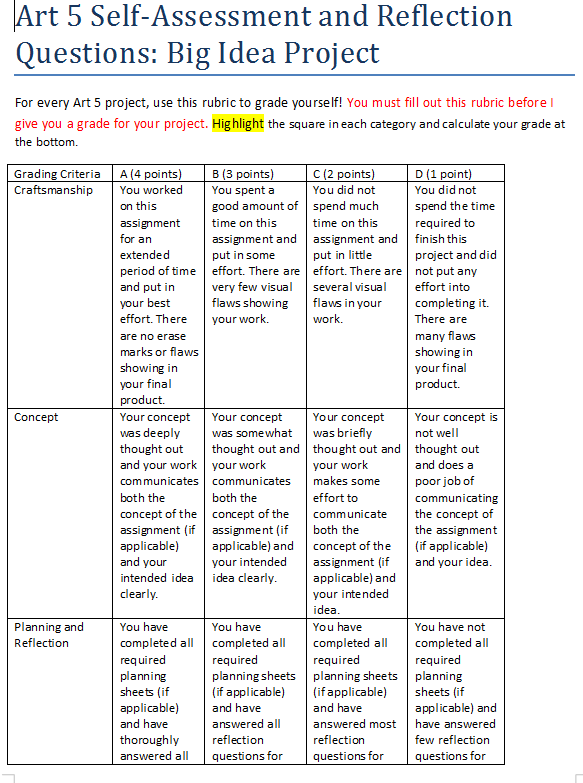
The conclusion of this process is reflecting upon the piece and self-assessment. In Art 5, students are encouraged to grade their own work in order to develop their skills of selecting work for a portfolio. They are also asked to answer reflective questions which differ based on the goal of the project. An example of one is below.

Adding progress checks to my Art 5 class has been very successful so far and I am receiving higher quality work from my students and having more conversations about their goals for each piece and how they are effectively communicating their ideas. How do you encourage process-oriented thinking in your classroom?


Friday, September 25, 2015

Addressing Weaknesses and Clarifying Concepts

This school year I am working on addressing common mistakes students have made during previous years at the beginning of a lesson so they can be more successful this year. I am doing this through a short weekly video announcement.


Each video presents 3 tips for the current project. I am getting a good amount of student views on these videos. Aside from increasing the quality of student artwork, these videos also serve as a weekly greeting from me that my students see when they enter the classroom. 

Monday, August 31, 2015

Student Recognition


The new school year is up and rolling! I always enjoy the energy and inspiration that come at the beginning of the school year. I am feeling well rested and ready to conquer the world! One of my many goals this year is to make my students feel special. In the online classroom, the key to student engagement is to make students feel cared for and noticed. One of the ways I seek to accomplish this is by creating a weekly student art gallery. I use Animoto (which offers free educator accounts with pro features!) to create an exciting gallery video each week.


I have always posted this gallery for students to access, but this year I am also emailing students who earn a spot in the gallery video to let them know how proud they should be. I send along a certificate which they can print and hang up if they desire (seen at the top of this post). I am hoping this little bit of extra effort gets my students feeling excited about creating artwork and feeling valued in their classroom community. 

Monday, August 3, 2015

Keeping Parents and Students Informed

My summer school course has wrapped up and was a very positive experience. I conducted a parent and student survey at the conclusion of the course about the efficacy of the course to help them achieve their goals and how their experience was. I received many positive results and one thing both my parents and students mentioned being helpful was my consistent communication.

Each week I sent out an email to students and parents about the subject of study for the week unit, assignments, and due dates. I have discussed emails like this in previous entries (Communicating with Students Part 1, Part 2).


The main new type of communication that I incorporated in this course was to email parents and students progress reports every other week. Because the course was only 5 weeks long, it was important to keep parents and students informed. As a policy, I always allow students to resubmit projects through my course after reviewing my feedback. Even though students had access to their grade books, sending these progress reports seemed to do a nice job of alerting students to potential issues and put parents at ease. A school may already have a schedule for sending out midterm and quarterly grades as mine does during the school year. I have found that student achievement improves when students are parents are more aware of what is going on in the online classroom. It was helpful to employ this knowledge to a summer course and to include detailed information about each assignment for everyone involved.

Click here to download the progress report template:
Word version
Pages version

Tuesday, July 7, 2015

Impressionist Landscape Watercolor

I have been really enjoying teaching my summer school class so far. My students are creating wonderful artwork and making meaningful connections with the world around them. It has been awhile since I brought my Google Glass out for a spin to create a demonstration video, but today I took it on an adventure in painting "en plein air".


I am very excited to see what students create for this project and I was happy to have an excuse to go paint outside on a beautiful day like today.

Monday, June 22, 2015

Preparing Brick and Mortar Students for an Online Course

This summer, I have the pleasure of working with a group of students who normally attend classes at a brick and mortar school but have enrolled in my online summer art course. I have spent the last several weeks creating a compressed 5-week beginning art course for these high school students and I have really enjoyed building the course and experimenting with a new (to me) LMS, Moodle. I created a syllabus and a welcome letter for parents and then I took some fantastic advice from my colleague Teresa Potter (blog here), to make an introduction and planning activity to help students be successful in an online course.
While most of the year I am working with students who are already very familiar with online learning, these students may be taking an online course for the first time. And they're taking an art course at that, something that confuses even my online veteran students. So I used a part of Teresa's design and combined it with features I have always used in my courses to make a worksheet that would guide students through the freedom they have when working in an online course. Students get to decide when they will work, how they stay focused, and how to be successful in an environment that is not structured for them. 
First, I created a tip sheet for students about how to be a successful online learner, specifically in my art course.


Things you can do to help yourself be successful in this course:
  1. Build class time into your schedule: Just like having English class from 12:00-12:50 Monday-Friday, time spent learning in this course should have a dedicated time in your day
  2. Familiarize yourself with deadlines: Print a copy of the class schedule and/or mark deadlines on your calendar
  3. Be prepared: Get your art supplies early so there is nothing holding you up from completing your work on time
  4. Practice with technology early, and have a backup plan: Technology does not always cooperate with us on our time table. Make sure you test for problems and find a solution or ask for help well before the deadline.
  5. Take notes: When watching videos or completing readings in the classroom make sure you take notes and write down ideas that emerge to refer to later
  6. Ask for help: Unlike in a traditional classroom, I cannot see if you are struggling. Make sure you keep me informed of any issues and reach out to me for help-it’s why I am here!
  7. Read your feedback: I will provide detailed feedback for each assignment in this course and this feedback will be instrumental in helping you improve and grow.
Second, I put together a Getting Started Activity which students are expected to complete the very first day the class begins. This beginning portion of the sheet consists of the questions below:


1.What do you know about art?

2. What is you favorite subject?

3. What do you hope to learn or achieve in this course?

4. What is the best phone number and time to reach you?

5. Do you prefer calls, texts, or emails to communicate?

6. What are 3 things I should know about you? (interests, hobbies, learning styles etc.)

I use questions like these to help myself get to know students, learn how to contact them, create talking points for building rapport, and get a general idea of what students hope to gain from the course so I can address their needs. 

The second portion of the sheet is all new to me. It asks students to plan a schedule of when they will complete their work for class and I listed which assignments they need to plan for. 
This activity allows students to take ownership of their learning plan and emphasizes the importance of staying on top of their work. Even my online veteran students could really benefit from something like this. Previously I have offered little help in my own course when it comes to encouraging student planning, but perhaps if I encourage student planning early, students will be more successful. 


Friday, March 27, 2015

Facilitating Individual Learning Synchronously

This semester has been a very busy one. As all teachers know, each group of students and each student we teach is different from the last. Last semester I had a very independent class as a whole who did not generally find synchronous sessions to be necessary to attend. This semester, I have a group that finds my synchronous sessions to be the ideal place for them to complete work and I have many students who attend once or twice every single week.
In general, I would say that online education encourages students to be more independent than they would be asked to be in a brick and mortar setting. Students need to be able to find and access lesson material independently and need to take steps to ask for help when they don't understand something. This can be particularly difficult for students who special needs or who just learn better with structure facilitated by a teacher and direct instruction. I have students on both ends of the independence structure this semester and I have been able to create a synchronous environment that students who need more structure seem to enjoy and depend on each week.

I have written about my Open Art Room before, but this semester is has been used more than any other! I now have step-by-step powerpoint presentations of every single art project in my Art 1 class and students are eating it up. I put my slides on "roam" so many students can access different pieces of the content at the same time as needed. I have also been able to employ students' webcams for them to show me their work in progress and once it is complete. Open Art Room provides students a space where they can get the lesson content in a different way than reading the classroom pages and get individual help along the way.

Friday, January 30, 2015

Course Building

As I continue to learn about the various best practices for creating curriculum for online learning, I have chosen my Art 5 course as the curriculum that I am going to beef up in my University of Cincinnati course on curriculum design for online learning.
I have revised this course several times since I began teaching it 3 years ago. At first, I set up the course in an independent study style where I expected that students would be able to design, plan, and create their own art projects. I assumed all of my students had enough experience in 4 levels of art before my course that they would feel comfortable being autonomous with a coach or guide giving feedback. What I found is that students wanted more direction.
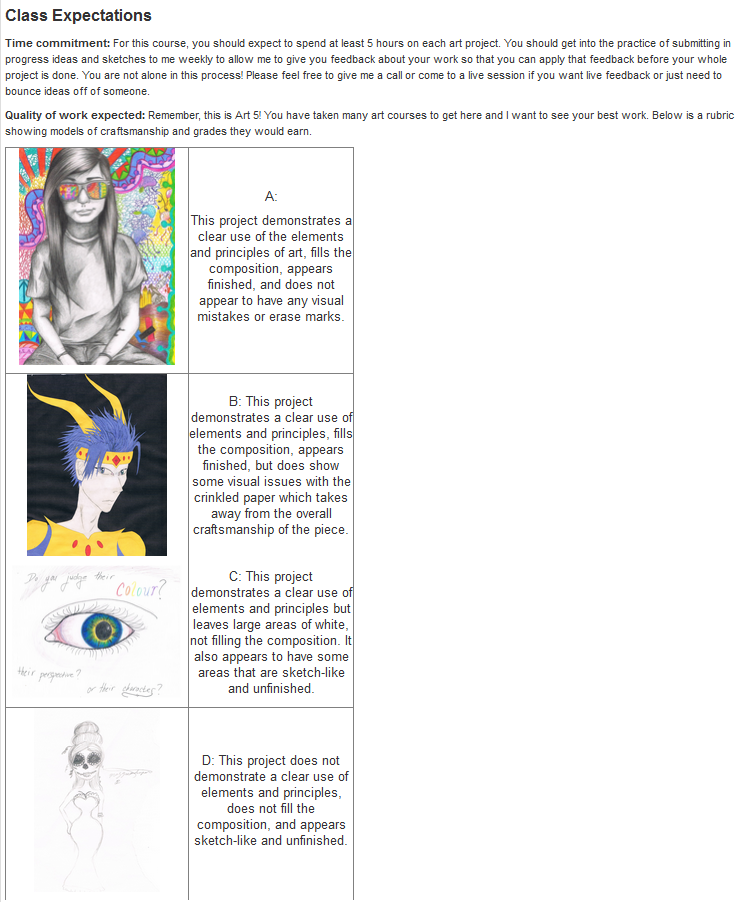
The second version of Art 5 included more conceptual direction for students with parameters for them to follow but freedom to choose materials and make compositional choices. For several years this has worked but I have noticed that students are not putting forth their best work technically or spending the time required on these projects. This is a challenge when working with students online because they do not have idle studio time to fill like they would in a brick and mortar classroom. They choose how long they work on a project and many times they do not plan for long enough when left to their own devices. This, along with the motivation from class has caused me to create a course overview page that explains to students what I expect of them.
I am also working on altering a few of my weaker lessons to include some technical demonstrations and challenges for my students. Other advanced/AP art teachers, how do you push your students to give you their best work? What kinds of projects would you offer for a portfolio development class? Any ideas are appreciated!

Friday, December 12, 2014

"Blank Space" Art Teacher Verison

Today I got a little crazy and made a new welcome video for my semester 2 classroom. I cannot wait to hear what they think!

Thursday, December 11, 2014

Whatever it Takes

I have hit a little bit of a static time within my classroom these past few months. I haven't had many new teaching strategies I've been trying as I have been focusing much of my time leading my colleagues in completing the Ohio 5-Step Process as Teacher Based Teams. Leadership is also the focus of the 4th year of the Ohio Resident Educator Program which I have been working on as well. It feels refreshing that this week I have finally been able to focus more on helping individual students.
As I have said before, one of the strengths of an online environment is being about to work with students on an individual basis, in fact it is much more rare for me to work with students as a group. This week I have been focusing on engaging students who have not been successful on their own as of yet. Previous to this week I sent out letters, made calls to parents and students, and sent countless emails to attempt to engage these reluctant learners.

This week, I tried putting my money where my mouth is so to speak and invited these struggling students to one-on-one synchronous sessions. For these sessions I prepared slides that walk students through each step of every project in my course. I invited students to attend via phone calls and individual emails (with their names in the subject line!). Once a student entered the classroom I would direct the students through each project step-by-step using the slides on the board and demonstrating each step over the my document camera. These sessions did get pretty lengthy but students were willing to stay, with the goal of passing the course at the end of our time working together. I'll be honest, until this week I have had lackluster attendance in my synchronous sessions, but these catch up interventions are working their magic on some of my most difficult to reach students.

Monday, October 27, 2014

Using Video Snippets in the (Online) Classroom

I have always been a proponent of video in my classroom. They offer great demonstrations of both vocabulary and techniques in a way that visual learners benefit from. Here is a link to some samples the videos I have created that fit into the demonstration category. 


Recently, I have started using videos in a few new ways due to the ability to pull in videos from sources like YouTube and embed them into my classroom pages. I use short, fun videos that I find to spark discussion via reflective questions. I have had a weekly discussion board in the past where I use articles from Scholastic Art to generate discussion, but I have found it is fun to mix up the sources that students are viewing, and it can lead to some great creative thinking! 


This is the first video I used in my discussion board. I looked for videos that were less than 5 minutes long and that could be used to prompt students to think about the big question, "What is art?" I asked them to reflect on the following:
1. Which definition of art from the video do you most agree with?
2. Do you think “bad” art still art? Why or why not?
3. At this moment, what do you think is the most important function of art?
At this point in the course, students have had a little bit of exposure to different styles of art but have mostly focused on drawing techniques. I really enjoyed reading their responses, especially from the third question as it prompted a great range of ideas from personal expression to visual communication and everything in between. 


The other more recent use of videos in the classroom is a variation on recorded live lessons I have used in the past. I have always recorded my synchronous lessons for students to watch at a time which is convenient for them (check out this post for more information on how that works). However, due to a shift in focus this year in my live instruction schedule, I haven't had a high attendance rate for my lessons each week. With this change and the availability of a new tool called Screencast-O-Matic I have begun to make lesson snippets: an overview of lesson content for the week summed up in 5-10 minutes. This week I am out of my office for much of the day due to state testing, so it is especially important that I was able to post a short lesson video into my weekly announcements for students to access this week while they are working. 

Monday, June 9, 2014

Reflecting on the 2013-2014 School Year

Wow! What a year it has been. It is hard for me to believe that it is once again June and that this weekend, 2,560 students from my school have graduated. I couldn't be more proud. I feel so lucky to be a part of their lives and help them be successful. Every year at graduation I get to personally congratulate many of my own students face-to-face for the first time and this year was no different. I received hugs and smiles and I cheered each of them on as they proceed to their next stage of life.
Much like our students, the school year is full of learning for teacher as well! This year, my third year of teaching, I have learned so much and experienced many new challenges and celebrations.

I began the year armed with a new tech tool: Google Glass! I used it to make demonstration videos for my students and also to make videos explaining art concepts like linear perspective and getting inspiration from the world around you. The students responded positively to my videos with a higher engagement rate than I've ever had before and better quality work. These videos have become a permanent fixture in my art classroom and I continue to use Glass to make new resources for students. Hopefully next year I will be able to try out a virtual field trip! Also tech related, many of my students received tablets to access and complete their school work. Though I didn't have much time to implement tablet lessons this year, next year students will have the option to complete some of their art projects on their school tablets in order to give them more exposure to digital art and solve supply and scanner issues. Students will also be able to use them to photograph their work so 3-dimensional media is finally possible in my classroom!
This year, I experienced a training about Formalized Instructional Practices where I was reminded of the value of measuring student learning through all parts of the instructional period and also how to help students set their own learning goals. I have now implemented FIP into several of my lessons and the majority of my synchronized instruction. I am excited to further implement these strategies next school year.
I also learned how to best prepare my students for Student Learning Assessments so they meet learning targets. This new practice of evaluating student learning in the art classroom was very challenging for me as my students barely met the minimum growth the first time I gave the test. For the second time around I used study guides, review games, and increased the number of motivated students taking the test. Because I teach online, students are able to choose to take my SLA rather than being required to. This was a tricky issue to combat but a much higher percentage of my students hit their growth targets the second time around.

I implemented a discussion board in my classroom for the very first time this semester and even though it was extra credit, I received extremely high engagement. I asked students to reflect on contemporary and relevant questions about art. I used Scholastic Art magazine to start the discussions. I learned that some of my questions were more text-dependent than others and not all of the questions inspired high quality responses. I also only tried a handful of assignments where students needed to respond to each other. Next year I would like to implement more responses that encourage student-to-student interaction and improve the questions to be more text-dependent.
It has been a fantastic school year and as always, I am excited to take what I have learned and make next year even better. To close this entry I wanted to share an email I received from one of my graduating seniors this year. I feel incredibly lucky to do what I love every day and to make a positive difference in my students' lives. This is why I do what I do!

Monday, May 5, 2014

The Open Art Room - Creating Structure as a Team

During my first semester this year, I had a student ask to meet with me one-on-one in our synchronous classroom software, WebEx. Often when I am trying to help students get caught up with their work, we meet and discuss which assignments to focus on and I can show them examples of the projects and answer any questions. I also showed this student demonstrations using my document camera. He really found our meeting helpful and we continued to meet like this once a week until the semester ended. He told me that working with a teacher like this made him feel more like he was in a classroom, like he was not working alone.
This got me thinking, how can I regularly create this environment for students? After speaking with some of my colleagues, "Open Art" was born. Open Art is offered to students once a week. The session is run by myself and 3 other teachers and it is open to students in any of our sections. During the session, we walk students through each step of the weekly project, demonstrate over the webcam, and answer questions as students work individually. We allow students to work at their own pace by letting them roam freely through the slides after we have reviewed them. At the end of the session students will have their project done or developed enough to finish on their own.
Here is a sample presentation from one of our sessions:


We have seen consistent attendance at these sessions and find that students appreciate the extra structure that Open Art offers them. Students know that they can plan to do their art homework during the session and can have someone there to guide them through it. Also during these sessions, our special education teacher is able to open breakout rooms to work with students one-on-one. It has been wonderful to collaborate with other teachers on my team to make sure these sessions run smoothly. I will definitely be implementing Open Art again next year!

Tuesday, March 18, 2014

My Experience as an Online Student-Take 2


Last year, I took a MOOC (massively online open course) focusing on an Introduction to Spanish, which I signed up for through Class-central.com. I wanted to see what it was like to walk in my students' shoes and take a class online. I learned a lot from my experience and though I succeeded in "passing" the class, I ran into many issues that stopped me from doing my best. See the post here.


Now, almost a year later I decided to take another online course. This time, for the fun of learning and because of the topic! The course is called "The Music of the Beatles". As a huge Beatles fan, I was intrigued and excited to take this course. And, the experience was completely different from my online Spanish class.


I started excited and continued strong through all six weeks of the course. Each week I watched all the lectures, participated in the discussion board, and aced all the quizzes. I ended the course with a 97% and much historical knowledge I did not previously have about the Beatles. The course did not get pushed to the side in my mind and I never failed to make time for it. It was easy to be highly engaged in this course and I have several ideas about why.


What worked well:
  • Interest in the topic
  • Getting to know you survey to begin the course, and asked to introduce ourselves to our classmates
  • Class map where each student pinned where they are from (over 10,000 students took this course!)
  • Discussion board which was student-led where the professor actively participated as well
  • Facebook community for the course created by students. This was a big plus for me, as I am on Facebook all the time, I would see posts on my news feed about what my classmates were discussing so I would think about the course several times a day.
  • Students actively learned as a community by researching and sharing external resources from youtube and other sources that deepened the concepts we learned in the lectures
  • Video lectures where the teacher showed his face and his personality! Videos were informative, broken into small chunks, and visually appealing.
  • Released course content one week at a time with deadlines
  • Instant feedback from quizzes

I believe these practices helped me be the best online student I could be and I hope to employ as many as I can into my own course.

Friday, February 7, 2014

Getting Students Talking

Lately, art teachers have been focusing on creating more opportunities for reading and writing in their classrooms to align to the Common Core. This semester, I have begun using the discussion board in my classroom to provide students more opportunities for writing, but also in hopes of creating more of a sense of community in my classroom.
Each week, students have a prompt to respond to that uses an issue of Scholastic Art Magazine. This magazine has fantastic digital resources I would recommend to anyone trying to expand their text resources in the art classroom. I have tried to keep these prompts fun and intriguing to encourage engagement.
For Week 1, I wanted insight into students previous experiences with drawing and art. I found an interview with Tim Burton where he discussed his experiences as a student throughout school. I asked students to respond to the following:
Read or listen to the interview by Tim Burton (an artist who has worked on The Nightmare before Christmas, Corpse Bride, Edward Scissorhands...etc.).
1. Why do you think some children stop enjoying drawing?
2. When has a teacher inspired you in school?
The results have been very impressive. 73 of my students responded to my prompt which is an extra credit assignment in my class. Below is a student example.
During the first week, students were responding to me only. I made sure I replied to each student to show I am reading their responses and to model communication with others in the discussion board.
During the second week, I asked students to reply to each other using the prompt:
Read the article "Is there Art in your Xbox?"
1. Do you believe video games are art? Why or why not?
2. Respond to a classmate's post
Below is a student example:
As you can see, student responses started out generic. I provided feedback to help students expand their thinking and make sure they address specifics when replying to a classmate. I am hoping to see growth in their responses throughout the semester. So far, I am happy to see students engaging in this type of assignment and with each other.
                      

Wednesday, January 22, 2014

Success!

I have concluded my semester 1 with my highest ever passing rate as a teacher. 74% of my students passed Art 1! I believe the passing packet and my other efforts to engage students during the last 2 weeks of the semester really made the difference this time.
The method I used:
1. Send out mid-term grades for the 2nd quarter.
2. Send the passing packet to all failing students (see previous entry)
3. 2 weeks from the end of the semester, send each failing student an email with the subject line, "Name, you are X assignments from passing!" outlining some assignment suggestions to get them to a passing grade
4. 2 weeks from the end of the semester, call each failing student to tell them about the email
5. Last week of the semester, call each failing student who has not completed the work assigned in the email and remind them of the amount of time they have left to complete it
6. Provide an extension of the weekend to complete all missing work

With this method I was able to engage my reluctant learners so they could succeed and earn their required fine art credit. I'll continue to use this method next semester and hope for similar results.

Friday, November 15, 2013

Remembering Why We Do This

For the past few weeks, I have been collecting data from my post-test for my SLO. I wrote about this test earlier this year when we implemented it for the first time. At my school, this test is 23 multiple-choice questions offered through a website outside of our LMS. Students take this test during the first 3 weeks of school and the first 3 weeks after quarter 1 of Art 1. I started this journey feeling very upbeat and excited to see what my students came into my classroom knowing and how they would grow throughout the quarter. What I have found is some unsettling data.


At the moment (several hours before the closing of my post-test), I am sitting at 58.9% of my students hitting their growth targets. That puts me in the "Least Effective" category as a teacher. Throughout my young career as a teacher over these past 3 years, I have been told nothing but good things about my teaching methods by administrators. My students have given me positive feedback about what they are learning when I speak to them and I have generally felt fulfilled and proud of where I am as a teacher. These results threw a wrench into my teacher ego!

As it is, I am still not sure what is causing my students to do so poorly. I know of the barriers we have that might affect their performance; students not engaging with the content, test anxiety, students tired of taking all of these assessments (one per class, 2 times in 10 weeks), the weakness of multiple-choice questions to assess project-based learning, home environment, test questions with confusing wording, and a lack of effort to name a few. I have gone through many days of discouragement this week, feeling like everything I have learned about education is wrong and all the compliments about my teaching methods have been lies.

But then, I started to look at the data more closely. I began to see students growing by leaps and bounds! Some of my weakest performers have grown by the highest percentage. I even have students who have scored 100% on my post-test. When I was inputting the data of one of my students with special needs and saw that he not only hit his growth target but surpassed it, I jumped for joy! I was reminded why I am a teacher. It is not about crunching the numbers and hitting this arbitrary goal. It is about teaching each individual student and helping each of them grow. Maybe the data isn't showing it, but the students who have actively engaged in learning in my classroom have a wealth of new knowledge. I know this from talking to them, and from watching their work improve every single week.

I will continue to troubleshoot my assessments for my SLO and how I can overcome these barriers so the data starts to really reflect more of what is going on in my classroom. But, there are just some things that you can't quantify.

Am I a least-effective teacher? I certainly don't feel like one.

Wednesday, July 3, 2013

Practicing with Glass: Proportion Lesson

I picked up Google Glass last week and I am eager to start making videos for my classroom. They take a bit of getting used to so I am starting to practice before I go on vacation for several weeks. Here is my first clip that I will combine with more about the lesson later on for use in my classroom. It demonstrates the basics about proportion, foreground, middle, and background. Let me know what you think!

Wednesday, June 19, 2013

Google Glass Lessons

I have just ordered Google Glass and I am so excited about using it in my online classroom. Here are some ideas I have come up with so far. Check in to see how they are received by my students!


Virtual Field Trips
I would stream field trips to art museums around the state through Glass. Students would be able to “attend” the field trip by logging into a live session and could ask questions and participate in the field trip while Glass acts as their eyes and ears. Sections of the field trip could also be recorded for watching later in the asynchronous classroom.

Demonstration Videos
I will make a large collection of art demonstration videos to be used in all 4 sections of Art 1. These videos would show students how to use drawing techniques, what to look at when drawing from observation, and how to set up a still life scene. I would like to have one of these videos in each week of our semester course that students could access any time in the asynchronous classroom.

Interviews and Artist Studios
I would visit local artists in their studios to discuss what it is like to be an artist and I could use Glass to show students the artist’s work. Students would get a taste of a “day in the life” of an artist.

Perspective and Proportion
I would use Glass to teach students the difficult concepts of perspective and proportion. By students being able to view the world from my eye level, I can show them how objects get larger as you approach them and the objects in the background are smaller and how to capture that concept on paper. When I teach student about linear perspective they can view buildings through my eyes and see what a vanishing point looks like if they were to stand right in front of it. Many concepts in Art 1 involve students looking at the world in a different way. These lessons could help give students a more authentic experience that will help them understand the content better.

Stay tuned for more!