After a bit of a rough semester due to lack of attendance in my live sessions, this semester I have decided to re-focus my efforts on rapport and community building in my classroom. I have several new techniques I am trying in order to do this, but I wanted to share one of these today.
This school year, I have been using a screencasting tool called Screencast-o-matic to provide snippet lessons to my students (more about that here). This semester, I have also been using this tool to provide personalized feedback to my students about their artwork. Below is a sample:
Video feedback allows students to hear what I have to say in my own voice. It also allows me to draw on the screen in a more animated way than I have been able to before-see here. See below.
I have found that about 80-90% of students watch these videos (something I was not able to track before) and students seem to be more willing to make a revision and resubmit than they are with written feedback alone. I am enjoying giving students feedback in this way and hope to see even more improvements in their work throughout this semester as well as improved rapport!

This blog describes my day to day experience and reflections as an online art teacher. This blog was used in part for my Master's Thesis project. I thank everyone who has read it. Though my project is complete I will continue to use this blog to share my experiences and answer questions.
Showing posts with label arts. Show all posts
Showing posts with label arts. Show all posts
Sunday, February 8, 2015


Thursday, September 12, 2013
From Recall to Higher-Order Thinking
This year is all about growth! Both student growth and teacher growth. With common core and an increased focus on literacy in the art classroom, we are challenged to look at our weaknesses and evolve to meet new standards of learning. Last year, my team and I spent a large amount of time working on converting our curriculum to include more writing and reading. Two years ago, I went through the process of adding quizzes to my classroom to check student's ability to recall the information they were assigned to read. This mostly assured me that students were being held accountable for reading the material as sometimes they would get away with simply completing the project by looking at examples. Now, my task is to take a basic recall quiz and turn it into one that pushes students to answer questions about comprehension, application, analysis, synthesis, and evaluation.

I used a very simple and helpful guide I found on pinterest to learn more about how these questions could appear in the art classroom. Then, I reflected on my current quiz questions which included one such as this:
1. Which objects appear the largest in a drawing?
A. Objects in the foreground
B. Objects in the middle ground
C. Objects in the background
The answer to this question was simply provided in the assigned reading and it does not ask students to apply their knowledge. So I came up with a series of new questions that challenge students to apply and then analyse.
Examples:
Apply: In this image, which part is the foreground?

Analyze: Which option shows the correct use of proportion?
Analyze: Which option shows the correct use of proportion?

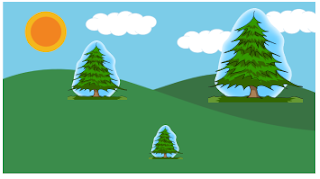
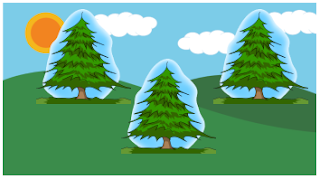

And I have even added a question where students have to choose the drawing that shows the most depth in order to fulfil the evaluation question. I believe these new questions will test more than if my students can read the information and put it down on paper but if they actually understand it.

I used a very simple and helpful guide I found on pinterest to learn more about how these questions could appear in the art classroom. Then, I reflected on my current quiz questions which included one such as this:
1. Which objects appear the largest in a drawing?
A. Objects in the foreground
B. Objects in the middle ground
C. Objects in the background
The answer to this question was simply provided in the assigned reading and it does not ask students to apply their knowledge. So I came up with a series of new questions that challenge students to apply and then analyse.
Examples:
Apply: In this image, which part is the foreground?


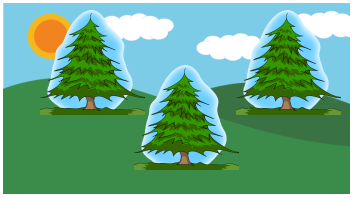

And I have even added a question where students have to choose the drawing that shows the most depth in order to fulfil the evaluation question. I believe these new questions will test more than if my students can read the information and put it down on paper but if they actually understand it.
Thursday, August 22, 2013
Welcoming
Over the last week I have been preparing my classroom for students. Now, of course that doesn't mean I am putting up posters or arranging chairs and supplies. For me, it's all digital organizing. I've been pulling web content together from my Gold Course (houses all of the Art 1 curriculum pages) and making my own adjustments. One of these adjustments includes a welcome video message to my students which I hope will help ease their fears of being judged on talent in my class. A common barrier I run into with students is their belief that they cannot draw, and therefore will fail my class. I spend many phone calls convincing them that this isn't true. This year I created a video to address this concern right away, and it also let's them see my face on their first day.
I also created another Glass video about my Pattern Project. I am hoping to engage and excite students with these videos year. Tomorrow, my students begin the 2013-2014 school year. I look forward to our adventures!
I also created another Glass video about my Pattern Project. I am hoping to engage and excite students with these videos year. Tomorrow, my students begin the 2013-2014 school year. I look forward to our adventures!
Friday, August 9, 2013
Preparing for a Better Year, Every Year
I have had a long and exciting summer and I getting very excited for the 2013-2014 school year to begin. Between new technology tools, implementing common core standards, and carrying out SLO's, we are in for some big changes. I am working on bettering my asynchronous content through more varied visual examples. At the end of last school year, I surveyed my students about how they best learned in my class. The results surprised me.
 I had an idea that my WebEx lessons (live/synchronous lessons) would score highly with my students, but I was surprised at how helpful they found my step-by-step instructions. Last school year only 2-3 of my lessons actually had step-by-step lessons pages. Therefore, I have big goals for this year! I know that I want to implement step-by-step guides and videos into every lesson in my asynchronous content. Google Glass continues to be an innovative and convenient way to do this. Below are two new lessons that are ready to go for my classroom. One is a step-by-step guide, and one a video, both made using Glass.

Wednesday, June 5, 2013
Motivation Frustration

Here are the methods I am focusing on this week:

- Passing instructions: I started my mission to save my failing students with an email that listed all the assignments they could choose from and how many they need to do in order to pass my class. Sometimes it is a little disappointing to know students want to do the bare minimum to earn their credit, but as teachers we all know this is true sometimes and it is easier to motivate a student when they feel the goal is within their reach.
- Phone calls: Reaching out to students over the phone is sometimes the make it or break it in their motivation. It's easy to forget they are more than just a overlooked name in my classroom if I do not reach out to them. As I have spoken with my students who are failing this week, many of them have been thankful for my call and already working on the assignments they need to submit.
- Personal emails: Not all of my students answer me when I call, and sometimes their numbers do not work. At this point I turn to emails, but they still need to be personal. Now, instead of many options for passing I have moved to specific assignments for each student to complete that will push them to a passing grade. I look at the number of assignments they need, pick the ones I want them to do, and send out the message with a read receipt. I have found that for some students, a specific list is more motivational than many options. To remind students that these emails are personal I put in the subject line "Passing instructions for (student name)" or if they are only one assignment away from passing it will say "(student name) you are ONE assignment from passing".
- Offering extensions when possible: Deadlines are important as they give procrastinating students a reminder that they really need to get it done. However, when possible, offering extra time gives students the extra push they need to know that you care about their success enough to grant extra time. I never offer this extra time until the very end so as to not promote more procrastination.
Wednesday, February 20, 2013
Aligning to Common Core in the (Online) Art Classroom
As the 2012-2013 school
year continues to tick by, we continue to align the Art 1 classroom to meet the
Common Core State Standards (CCSS), which will be mandatory by 2014-2015.
Though it seems far away, my teammates and I are already working towards 100%
alignment. Of course we all still have many questions. We spent last week
together in PD brainstorming ideas for aligning our Art 1 curriculum to the
CCSS. In many cases we are adding small written assignments to accompany
drawing projects. This has lead to some shifts away from reading quizzes and
towards short writing assignments. We also have changed some projects to incorporate
more ideas of visual communication as a form of writing. As far as CCSS, I am continuing to follow the idea that art is a text meaning students can read
artwork as a text and write artwork as a text to meet these standards.


One of the lessons we’ve
changed is the still life lesson. Before: students are instructed to choose 3
objects, set them up in a still life scene, and draw them using 7 different values.
After CCSS changes: students are instructed to look at examples of still life
paintings/drawings that tell a story. They will choose 3 objects that tell a
story (drawing instructions are the same as before) and they must title their
still life drawing something that describes their story. A rather small change
not only aligns with CCSS but also incorporates more meaning and excitement
into this project.
In addition to artwork as a
text, it is helpful to know what your school offers in the way of textbooks or
online resources to provide students with readings at grade level that go along
with your content.

In the texture lesson, students
currently learn the differences between simulated (2D) and tactile (3D)
textures and create a texture study by drawing out 4 different textures. We
thought this would be a good opportunity to have students look closer at
sculpture through an article in Scholastic
Arts Magazine. For teachers who don’t know about this resource, it is an
amazing way to align to CCSS. It provides articles, images, videos, and even
written and multiple-choice assessments for grades 4-12! Right now, all the digital resources including issues of the magazine are free, though at some point will become viewable only to subscribers. We are going to use
the section on sculptures from a recent issue to have students write
about the role that texture plays in whichever sculpture they choose.

Looking at our lessons to
align them with CCSS has allowed my team to focus on changing lessons that have
been weak in the past. A lesson many students have trouble with is our Cubism
lesson. Students learn about the style of cubism and about Picasso and Braque.
With this knowledge, they create 2 pieces of art, one that is realistic, and
one that is a cubist version of that same subject matter. We discuss the
differences and similarities between analytic and synthetic cubism but students
still have trouble with this concept, especially when it comes to making their
cubist artworks. Thus I have added a reading and sorting activity to this unit
to help students spend time looking at synthetic and analytic cubism more
closely. Students will get their reading from Encyclopedia Britannica
and use the reading to guide them in arranging characteristics of analytic and
synthetic cubism into the correct categories.
Whatever lessons you teach
in your art classroom, aligning to CCSS does not have to mean big changes and
extra work. Small changes and additions can make your lessons more meaningful
and help students succeed.
Tuesday, December 4, 2012
Thoughts on Common Core and the Arts
I just spent the last 2
full days learning about the Common Core State Standards (CCSS) and the PARCC
test that will go along with them. While at first overwhelmed and confused
about how to apply these new literacy standards to the existing art curriculum,
I have spent time researching what others are doing and working with my
teammates to come up with some ideas. I am now very excited about these new
standards. It has been said that the shift from the OGT test and current
standards to the PARCC test and CCSS will switch our focus as teachers from
teaching students what to think to
teaching students how to think. And
while the OGT’s never tested the arts, the CCSS for literacy is being
introduced as everyone’s responsibility. They even have specific standards for
us to meet, grouping all electives into a category called “other technical
subjects”. Though this gives us art teachers more to cover in our classes and
more curriculum to write, I am happily embracing this challenge to help our
students become better thinkers. It seems to me that the CCSS are here to
encourage us all to be better educators and really prepare our students for
college and careers. Looking at the standards there were many things I was
unclear about. One point of emphasis in the literacy standards was having
students read complex texts. At first I wondered where we would find these
complex texts for our students to read (online we do not have a text book to
refer to) and also how these complex texts might relate to visual learning. I started
googling “common core and the arts” and found a very helpful blog post (here)
that outlines how a piece of art can be a “text” that students read. This really
helped me get past my confusion and helped me come up with my first CCSS
aligned lesson for my Art 1 classroom. Students complete a project in Art 1 where
they create two portraits where at least one contains symbolism. In our live
session we look at Renaissance portraiture and how artists communicate to the
viewer about their subject such as personality or social standing. Though we
always discuss this topic, I never have them write about it. Therefore, this
lesson was one that could use a writing portion, and why not align it to the
CCSS? Below is the assignment I came up with that I will be trying out next
semester. It encourages students to “read” the pieces of art, analyze them, and
provide evidence for their conclusions (evidence is very important in the
literacy CCSS).
Portrait Analysis
You
will begin your study of portraits in this lesson by looking at and analyzing
the way that artists create portraits. Portraits often contain symbolism within them. Symbolism is the use of something that stands
for or suggests something else by reason of relationship, association,
convention, or accidental resemblance. When artists use symbolism in portraits they are
communicating about their subject to the viewer. For example, the type of
clothing a subject is wearing in a portrait can tell us about their social
class or the culture they come from. The objects surrounding the subject can
tell about them too, if they are surrounded by books perhaps they are a student
or scholar. For this assignment you will act as a detective to find clues
within 2 portraits that inform you about the subject of the work!

Artemisia Gentileschi,
1615
Self Portrait as a Female Martyr |

Paul Gauguin, 1886, Self-Portrait
|

Frida Kahlo, 1940
Self-portrait with Thorn Necklace and Hummingbird |

Kehinde Wiley, 2007,
Dwayne I
|
Your
Assignment
|
|
I am just beginning this
task of aligning curriculum with the CCSS but I expect I’ll be posting more
lesson ideas soon!
Subscribe to:
Posts (Atom)